%20(19).png)

.svg)
State of Survival v1.25.400 Warship Mini-Map Changes
.png)
.png)
.png)
.png)
.png)
.png)
.png)
.png)
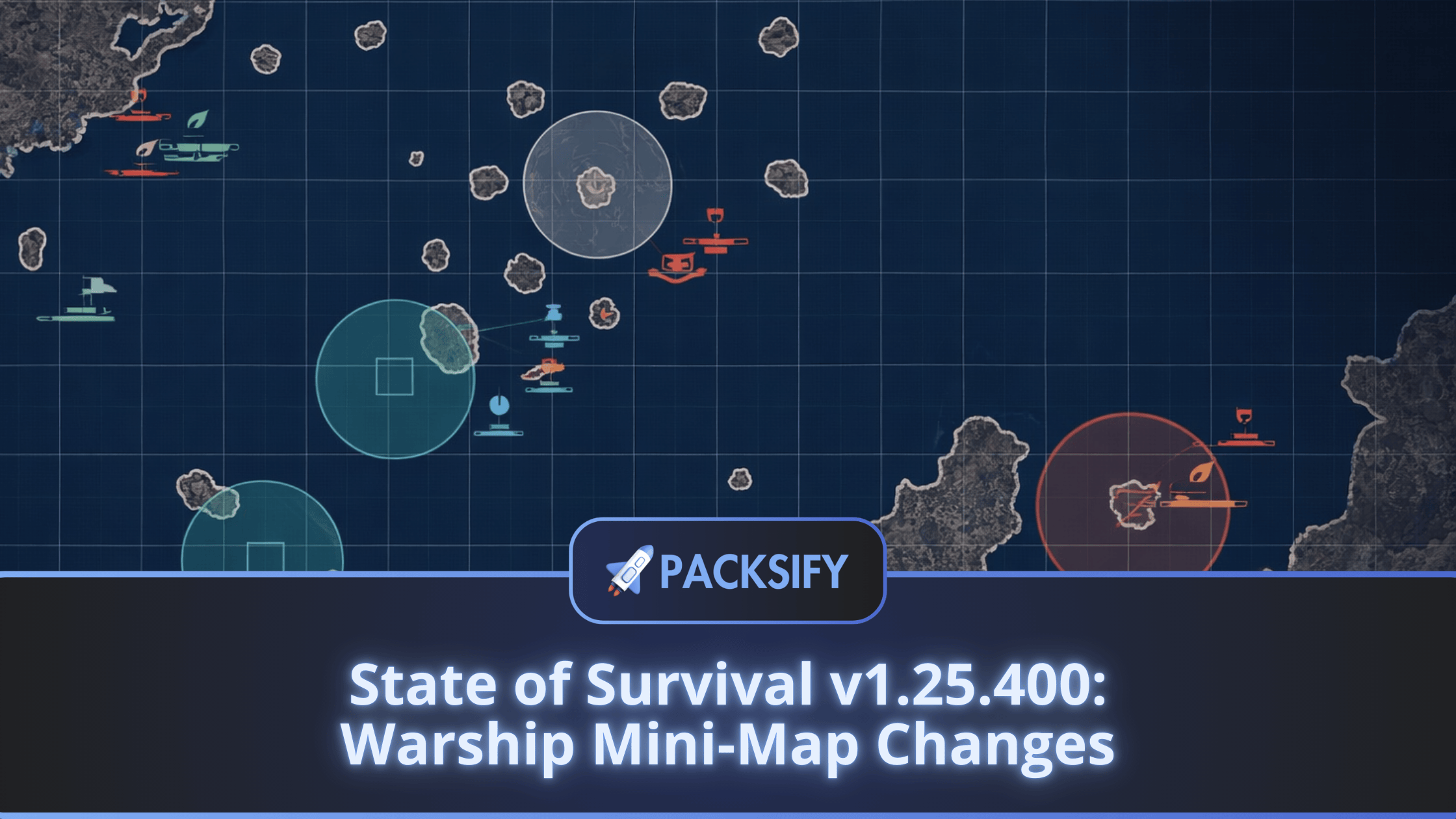
With State of Survival v1.25.400, alliance warships are now visible on the mini-map during events like Abyssal Skirmish.
On the surface, this looks like a clarity upgrade. In practice, it changes how formations are read (and how assignments should be made), often in ways alliances aren’t prepared for.
Before this patch, leaders relied on inferred positioning: rally markers, chat confirmations, and experience reading troop flow.
The mini-map now adds a live layer of information that compresses decision time. When used correctly, it prevents misplays. When misunderstood, it actively causes them.
This article focuses on what alliance leaders must change in formations and role assignments to avoid bad rallies and wasted boosts under the new visibility rules.
All observations are grounded in the official State of Survival v1.25.400 patch notes and live event behavior.
How the Warship mini-map changed in v1.25.400 State of Survival
The critical mistake many alliances make is assuming the warship mini-map tells the whole story, but it doesn’t. What it does provide is confirmation, not intent.
You can now see where alliance warships are positioned relative to objectives and engagement zones. This helps leaders identify over-stacking, empty lanes, or delayed support faster than before.
But it also exposes a new risk: members reacting visually instead of following assignments.
We’ve already seen alliances lose cohesion because players chase visible warships instead of executing their designated role. A hitter abandons a flank rally because another warship “looks closer.” Support joins the wrong engagement because the mini-map implies urgency that leadership never called.
Leaders must explicitly redefine how the mini-map is interpreted: it is a diagnostic tool, not a decision-making override. Officers should use it to validate formations, not improvise them mid-fight.
Broader Abyssal Skirmish prep changes in v1.25.400
Formation and assignment adjustments alliance leaders should make
The warship mini-map forces a tighter separation between visibility and authority.
First, rally ownership needs to be clearer. When multiple warships appear near the same zone, members default to visual proximity unless leadership pre-assigns responsibility.
Leaders should designate primary and secondary warship roles per zone before Abyssal Skirmish begins, and reinforce that assignments do not change based on mini-map proximity alone.
Second, formation spacing matters more now. Clumping warships might look powerful, but it increases confusion on the mini-map and invites mis-joins. Slightly wider spacing with clearly defined lanes reduces accidental stacking and makes it easier to spot genuine gaps.
Finally, boost usage must be re-timed. With clearer visibility, some members trigger boosts early out of perceived urgency. Leaders should anchor boost calls to timers and objectives, not visual crowding. The mini-map shows presence, not readiness.
These changes don’t require more power but discipline. And discipline is where most Abyssal losses actually come from.
Preventing misplays and wasted boosts under higher visibility
Higher visibility increases psychological pressure. When players see activity, they feel compelled to act. That’s where misplays happen.
Alliance leaders should expect a short learning curve where members overreact to mini-map signals. The fix isn’t stricter control, it’s clearer framing. Make it explicit that visual information supports leadership decisions — it doesn’t replace them.
The alliances that adapt fastest will treat the warship mini-map as an audit layer: a way to confirm formations, catch drift early, and reinforce assignments in real time.
Those that don’t will burn boosts correcting problems that never needed to exist.
Where funding discipline quietly supports execution…
At this level of play, the challenge isn’t whether leaders are willing to spend. It’s whether spending stays predictable during heavy cycles like Abyssal Skirmish.
Formation discipline, rally assignments, and boost timing all assume that recovery and reinforcement are available exactly when needed.
When funding becomes noisy (failed payments, surprise charges, or rushed top-ups), execution breaks at the worst possible moment.
This is where a controlled funding layer starts to matter.
Experienced alliance leaders increasingly separate execution decisions from transaction handling. Spending is still deliberate, but it runs through systems that keep funding planned, transparent, and safe.
Packsify operates in that layer. Leaders use it so funding remains stable during high-pressure events, allowing the alliance to focus on formations, assignments, and outcomes — not payment friction.
When funding stays predictable, the mini-map becomes what it’s meant to be: a tool for cleaner execution, not damage control.
Same spend, more progression.
Packsify is built for players who outgrow the basics.