%20(19).png)

.svg)
Is Packsify Legit? The 7 Misconceptions Serious Players Ask First
.png)
.png)
.png)
.png)
.png)
.png)
.png)
.png)
If you're running a real account and someone tells you to hand over your login, your first move should be to ask questions. That's not paranoia. That's how serious players evaluate infrastructure.
This covers the 7 most common doubts, answered with the evidence that actually matters.
1. "They need my login? That's an immediate no."
The reaction makes sense. Every scam service starts the same way: ask for credentials, take the account, disappear.
The relevant question isn't whether login is required. It's what happens next and who is accountable if something goes wrong.
What actually happens with a Packsify order: a trained operator logs into your account for one purpose, completes the purchase you approved through the official app store, and logs out. No browsing, no secondary actions, no credential retention after the order closes. That boundary exists in writing and gets enforced operationally.
You can keep 2FA active. The operator handles verification in real time, with you on standby if needed. After 5+ years of operation and zero bans on record, that process has been stress-tested at scale.
The difference between safe and unsafe credential sharing isn't whether login is required. It's whether there's a real, accountable organization behind the process.
2. "Doesn't this violate the game's Terms of Service?"
Most games have language in their ToS about account sharing and third-party services. That language exists to protect against botting, fraud, account sales, and chargeback abuse — not against a player having someone complete a legitimate in-app purchase on their behalf.
Packsify purchases go through official Apple or Google Play channels. The developer receives full payment. The transaction looks to the game's servers exactly like a high-spending player buying through the normal flow. Because it is.
Account access for an approved purchase is not the behavior publishers target. What they target is automated activity, stolen payment methods, and chargebacks, and none of that apply here.
3. "I've heard about bans from third-party top-up services."
You've heard correctly. Many third-party services do trigger bans. The reason is almost always the same: stolen gift cards or stolen credit cards used to buy packs. The transaction goes through, the card gets charged back, the developer doesn't get paid, and the account gets flagged.
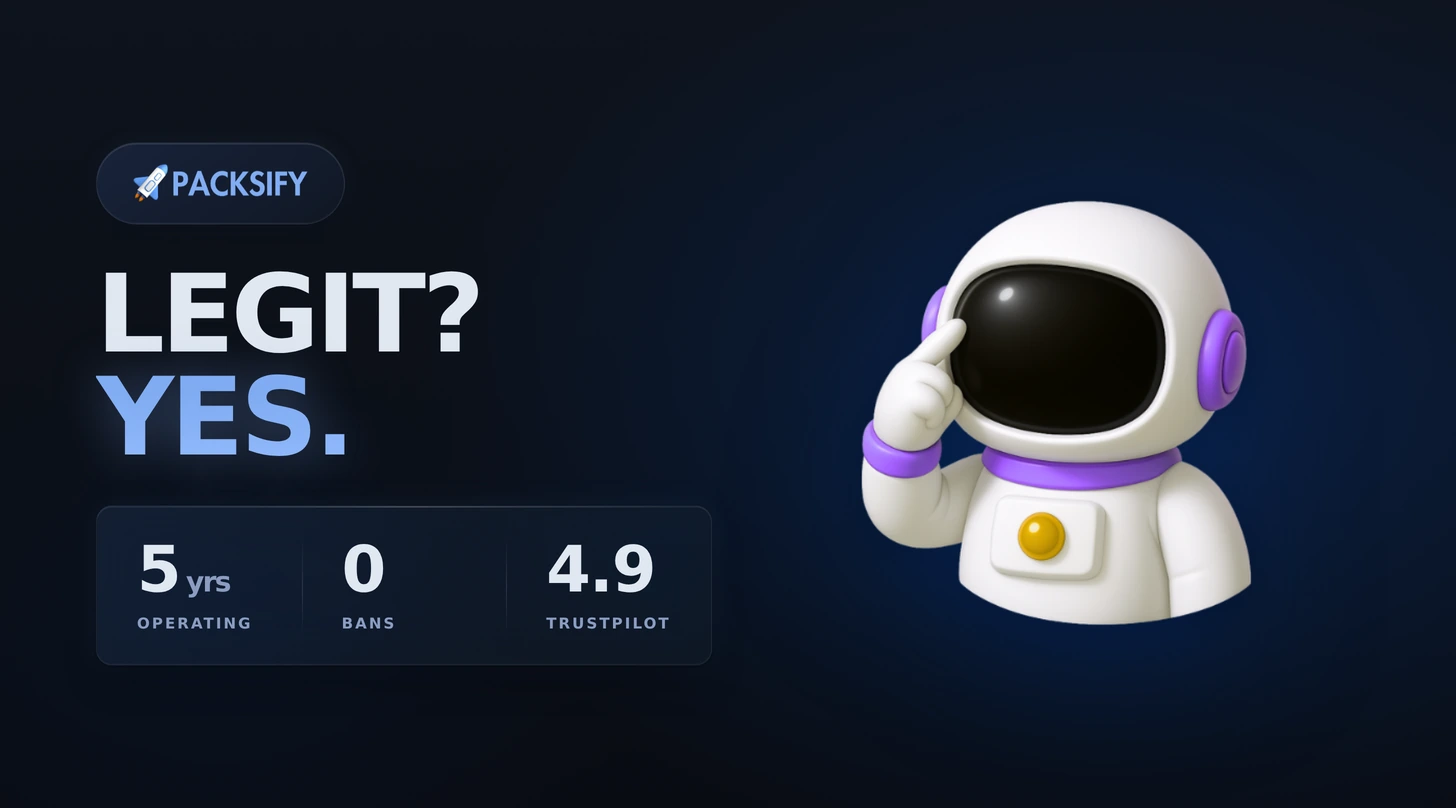
In 5+ years of operation, no Packsify user has reported a permanent ban from a properly processed order. That record exists because the payment method is clean, not because bans haven't been tested.
Packsify also carries a written Ban Protection Policy: if an account is permanently banned directly and solely due to a properly processed order, verified by documentation and clean account history, the balance is credited in full. In 5+ years, that policy has never been triggered.
4. "If it's cheaper, something must be cut."
This is the right instinct applied to the wrong model. With shady sellers, cheaper means something is wrong: stolen cards, grey market codes, account exploitation. The discount is real. So is the risk it comes with.
Packsify's model is different. Official Google Play and Apple balance is purchased at scale. Buying at volume produces better economics than a solo player buying the same balance retail. That balance is then used to complete your order at full in-game listed price through official channels. The developer gets paid in full. The purchase processes identically to any high-spending player buying direct.
5. "This sounds like a grey market operation."
Grey market top-ups work by reselling region-locked codes, exploiting carrier billing, or flipping stolen gift card balances. The common thread is that the developer doesn't get paid what they're owed, which is why those operations produce account risk.
Packsify doesn't sell codes. There's no resale, no arbitrage on stolen balance, no payment method that bypasses the developer. The purchase is made through Google Play or Apple App Store using pre-loaded balance. The developer receives 100% of the listed price. The receipt is real because the transaction is real.
That structural difference is what separates a 5-year zero-ban operating record from services that produce the horror stories you've read.
6. "If this were legit, wouldn't the game have shut it down?"
The developers know services like Packsify exist. The reason they haven't acted is straightforward: every transaction is paid through official channels, and the developer receives full payment every time.
Packsify is a US-registered company with a public Trustpilot profile, a Google Play listing, and a verifiable operating history. There's nothing hidden about the operation. The accountability is there because the model doesn't require it to be hidden.
What publishers pursue are services that cost them revenue or produce fraud signals. Packsify produces neither.
7. "This just sounds too good to be true."
The skepticism is correct as a starting position. Most things that sound too good to be true are.
What changes it here is the evidence trail: 5+ years of operation, a zero-ban record that's publicly verifiable via community search, a Trustpilot profile with real-name reviews, a US-registered entity, and a ban protection policy in writing. Each of those items is independently checkable.
The question isn't whether this sounds too good to be true. It's whether the evidence holds up when you check it. For serious players who've done that check, the math becomes hard to ignore.